
|
Rick Lee, the 62 year old masters distance ace for the Shore A.C. claimed four gold medals
at this year’s Pan American Masters Track & Field Champions which were held in Cleveland, Ohio, July 13-21. Top athletes from North American, South America, Canada and a variety of 70 other countries participated in this year’s event. Lee ran in four events, winning the 1500 meters in 4:38.48, the 2000 meter Steeplechase in 7:27.38, the 5k in 17:49.60 and the half marathon in 1:22:25.66. In addition to winning the 60-64 title, he also finished third overall in the half marathon. He won by large margins in each of his 60-64 races, and his time in the Steeplechase was just seconds short of the American record in the 60-64 age group set by the great Nolan Shaheed of California a number of years ago. Dr. Ivan Black, the club’s masters great sprinter/jumper specialist, 76, cruised to wins in the 80 medal hurdles (18:49), The long jump (11’ 5”), and the triple jump (25’ 83/4”), as well as winning a close silver medal in the 100 meter meters in 16.78 all in the 75-79 age group. Another runner in the 75-79 age group who did well was Dr. Harry Nolan. He led wire to wire to win the 800 meter run in 3:15.94. Over the two previous days, the 77 year old, who was coming off a minor case of pneumonia a few weeks before, had landed second places in both the 1500 meter (7:06.53) and the 2000 meter Steeplechase (10:52.60). The clubs top octogenarian, Rob O’Rourke, 81, who was recovering from a minor hamstring issue, limited his running to the 800 meter. Despite limited training over the last few weeks, he came through by winning the 80-84 race in a quick 3:18.64. Former Shore A.C. runner Christie Patla, running in the 50-54 age group landed a fifth place in the 5k race in 24:15.07, a day after placing in the triathlon event.
0 Comments
WEST LONG BRANCH, N.J. – The second Paris Olympic Games in 100 years (and the third in 124) is just seven-plus weeks ahead.
The second USA Olympic Track and Field Trials in four years at the brilliantly recrafted Hayward Field in Eugene, Oregon (and the eighth in Eugene in 52 years) is just two-plus weeks away. And now the second straight Elliott Denman International Meet held Sunday, June 2, at the Joe Compagni Track at Kessler Stadium on the Monmouth University campus, is in the books, too, as a stepping stone to what’s to come in those big ones just ahead. First staged in 1987 as the Bob Roggy Memorial Meet, the meet evolved into the New Jersey International a year later and now, in its 37th year, continues its original mission of displaying some of the sport’s top talent. Over 850 athletes – from at least 10 nations and 15 states - took part and they ranged from young boys and girls to upper-age-division Masters athletes. Following meet tradition, almost all events were named for greats of New Jersey / New York Metropolitan track and field over the years. Six athletes reached USA Olympic Trials standards; 16 Kessler Stadium all-time facility records went into the books; three all-time NJ International Meet records were set. At least 20 individual and corporate sponsors stepped up to make it possible. But – of course/of course/of course – just as meet directors Joe Compagni and Dave Friedman, meet coordinator Erin O’Neill, and their corps of Shore Athletic Club volunteers planned it, it was the elite-category athletes who stole the spotlight. There were highlights galore. *** Nick Dahl, a former Heptagonal/Ivy League champion at Yale and Atlantic Coast Conference mile champion for Duke, needed an all-out final 50-meter spurt to take the Dr. John Connors men’s 1,500 meters – concluding event in the meet – with a 3:39.73 clocking. (For all you Imperial distance-centric fans out there, Dahl was running 3:56 mile pace.) Hard on his heels were Georgetown grad Jack Salisbury (3:40.41), Mount St. Mary’s alumnus Colin Kelly (3:42.07), former Colorado runner Andy Kent (3:42.36) and 13 more. The first four are New York City-based Empire Elite Club teammates and training partners. “I passed Jack (Salisbury) with about 250 to go,” said Dahl. “Then he passed me at 150. But I passed him back at 50.” Spectators loved it, and so did the athletes. “I love running in late evening races like this,” said Dahl. “Conditions were perfect. And the meet was great, too. Really glad I was here.” *** Elite Feats Club’s (and Puerto Rico’s) Miles Lewis sped to a 10.26-second win in the men’s Frank Budd Memorial 100-meter sprint. **** The Chrissy D’Alessandro Shaheen Memorial women’s 1,500-meter race was a dazzler, too, with ex-Tennessee runner Taryn Parks (4:10.67) outracing New Mexico alum Stefanie Parsons (4:11.41) and Columbia’s Nicole Vanasse (4:11.95.) *** Dueling it out for top honors in the Rich Kenah men’s 800 meters were North Carolina’s Andrew Regnier (1:47.61) and Clemson freshman star Blaik Slavinski of Point Pleasant (1:47.75.) The companion Joetta Clark Diggs women’s 800 went to Delaware’s Kadence Dumas (2:15.44.) *** Saint Peter’s University/Shore AC star Casheive Blair claimed the Larry James Memorial men’s 400 meters in a quick 46.65. And it was Union Catholic High’s Isabella Murray (57.23) first over the line in the Aliann Pompey women’s 400. *** Both 3000-meter steeplechase races honored the memory of Glen Ridge’s Horace Ashenfelter, the historic Olympic champion of 1952 – and saw North Carolina’s John Tatter (9:13.72) and Boston AA’s Andrea Rodenfels (9:29.36, a meet record) take the men’s and women’s titles, respectively. *** In half-lap sprint action, Tennessee’s Nigel Green won the men’s Andy Stanfield Memorial 200-meter title in 20.82. A double women’s sprint winner was Silveri Hernandez (12.04 and 24.86.) A tight Renaldo Nehemiah men’s 110-meter high hurdles battle went to UConn star Terrell Williams (13.86) holding off Oral Roberts U. grad Israel Nelson (13.85) and Shore AC’s Tayshaun Chisholm (14.29.) *** Meanwhile, field event stars were not to be denied their share of the spotlight. Field action began with the men’s Ira Wolfe and women’s Oneithea “Neni” Lewis hammer throw events on the Saturday, June 1, prelude card. And Penn State’s Samaria McDonald got things rolling with a 212-9 win in the women’s event and Tyler Williams with a 245-4 whirl of the men’s ball-on-a-wire. The event name honorees, both of Shore AC, excelled, too. Multi-World titlist Lewis won her Masters, hammer, shot and discus titles. Wolfe medaled in the men’s Masters hammer. ** Rutgers University athletes, past and present, played key roles in Sunday’s seven-event field program. Claiming men’s victories were current Rutgers star Sincere Robinson, who took the Dr.Phil Shinnick/Herb Douglas long jump at 25-6 ¼; and recent Rutgers grad Perry Christie with a 7-0 ¾ clearance in the Mike Pascuzzo men’s high jump. Shore AC’s James Plummer, the past Penn Relays, IC4A and Big East discus champion for Rutgers, and former Central Regional High School great who’d been a finalist in the 2021 Olympic Trials, opened his 2024 season with a 186-0 spin-win in the Art Swarts men’s disc. Lehigh grad Lucas Warning (58-8 ¾) and Monmouth alumna Prisca Blamon (42-3 ¼) took top honors in the Al Blozis Memorial men’s and women’s shot put events. Errol Jeffrey, a former IC4A throws champion for Monmouth, returned to his old campus and netted seconds in the shot(56-3 ¼) and discus (163-9.) ***The memory of Bob Roggy, the meet’s original namesake, was saluted in the men’s javelin throw, won by Duke’s William Kahn at 212-4. The Barbara Friedrich Parcinski women’s javelin, named for the Manasquan High and Shore AC star who was the 1967 Pan-Am Games champion and 1968 Olympian, went to Rhode Island’s Julia Camezato (168-7.) *** The meet was hosted by Shore AC, in cooperation wth Monmouth University officials, and an array of Shore AC competitors turned in solid performances in all divisions of the meet. Not to be outdone by the youngsters, the Shore AC women’s quartet of Nora Cary, Debbie Braithwaite, Diane Rothman and Susan Stirrat raced to a women’s age-65-up American record of 13:50.83 in the 4x800 relay. The men’s Masters 4x800 crown went to Shore AC’s Brian Hill, Chris Rinaldi, Rafael Rivera and Dan Campbell in 11:18.44. Three-time racewalk Olympian Michelle Rohl lowered the U.S. 55 mile run record to 5:23.30 taking the Mary Conry Memorial women’s Masters mile, while Dickson Mercer ran off wth the gold in the Harry Nolan-Dr. George Sheehan men’s Masters mile in 4:42.90.. Dr. Norbert Sander Memorial 5,000-meter titles went to Shore AC’s Troy Hill (15:04.49) and Freehold Township’s SophiaBriggs (19:42.97.) *** Racewalkers made it a big day, too. A 35,000-meter (21.7-mile) walk opened the long Sunday slate and Marist University’s Marissa Scotio and Mansfield grad Angelina Colon seized the opportunity to claim Olympic Trials qualifying marks. Scotio walked her 87.5 laps in 3:42.39, Colon in 3:43:46. Later in the program Canadian Masters star Dmitrey Babenko won the men’s crown and Shore AC’s Maria Paul of Long Branch led the women in the Elliott Denman one-mile racewalk. **** Cheering all this at trackside were at least two dozen members of the extended Denman Family and Friends team. The meet again honored Elliott Denman, the West Long Branch resident who covered track and field, the Olympic Games and all sports in a much-honored 35-plus-year career as an Asbury Park Press sports writer and columnist; served as president of the Track Writers Association of America; was a “founding father” of the “new” Shore Athletic Club in 1964; served Monmouth then-College as its first Varsity track coach 1966-68; led Shore AC athletes to an array of state, national, world and Olympic honors; guided Shore AC and USA National track squads on multiple international trips, and served as a state, national and world track official. All this, along with his own career as a racewalker in which he was a 1956 USA 50K Olympian; 3K and 50K USA national champion in 1959; USA record-setter over the 52.8-mile London to Brighton, England distance, and raced to 33 straight NYC Marathon completions (1979-2011). “This was certainly a great meet,” said Denman, now 90. “But we’ll still try to make next year’s meet even better.”  By: John Spinelli ‘22
If there was a modern-day David vs. Goliath, this middle-distance runner would certainly be “David” in the iconic underdog story. This year at the 2024 Elliott Denman International Meet we honor a young woman who needs no introduction to New Jersey and USA Track and Field. Shore AC honors Professional Runner Allie Wilson ‘19. Before she gained national attention, she began her journey right here at Monmouth University and the Shore Athletic Club. During her time as a Monmouth University student, she worked as the Operations Coordinator for Shore AC under (then) President Walter MacGowan. “The Shore A.C. has had five different Monmouth Track & Field student-athletes work with the club over the last ten years, and they have all been super valuable in that role,” said former Monmouth University Head Coach and current Shore A.C. Vice President Joe Compagni. “Allie did an excellent job with the club and was also an amazing teammate at Monmouth. Wilson made history this winter by becoming a national champion this year in the 800 meters at the USA Track and Field Indoor Championships in Albuquerque, New Mexico Feb. 17 with a time of 2:00.63. Before the gun went off, Wilson was not predicted to be a contender for the national title. Unlike her competitors, at the time she was not sponsored by any professional club or agency. She had also never won a national title nor had she run in a World Championship. But after that race before she knew it, Nike would be calling her agent to get a deal ASAP. Only two weeks later she represented Team USA in Glasgow, Scotland, finishing fourth in her preliminary heat at the World Athletics Indoor Championship, an opportunity that was long overdue for her. Currently ranked top fifteen in the world in the 800-meter by World Athletics, Wilson will have to face some stiff competition to make Team USA again, however this time with better odds. Some of her friendly professional competitors include other well-known New Jersey athletes, like Ajeé Wilson (no relation) from Neptune Township and Olivia Baker from South Orange. Just recently to sharpen the iron, she ran 2:00 again at the elite Drake Relays in Iowa. Allie Wilson’s career first began to spark with the Monmouth Hawks under coaches Chris Tarello and Joe Compagni. For the first time during her senior year in 2018, she qualified for the NCAA Championships. Only one year later, while earning her MBA at Monmouth in 2019, she joined the All-American club with a 5th place finish at NCAAs in a time of 1:59. Even in college, representing a lesser known Division 1 school like Monmouth University, she has always been used to being overlooked in the discussion about national title contenders. . This critical year she now hopes to qualify again for Team USA at the United States Olympic Trials in Eugene, Oregon, June 21 and earn a plane ticket to Paris, France for the Olympic Games. But with this time compared to her attempt in 2021, the odds are much more in her favor. When I was a freshman, I had the pleasure of being her teammate on the track team at Monmouth University. Wilson exemplifies what it means to be a member of Shore AC: working hard to live out your dreams, giving back to the community to inspire people to give Track and Field a chance, and being humble and kind. She also proves what it means to be resilient. In the buildup to the Olympic year, she left the Atlanta Track Club to stay with her coaches, Amy Yoder Begley and Andrew Begley, as they moved to Indiana. This meant being unsponsored leading into an Olympic cycle, a risk that paid off as she was able to train on her own and pull through to win a national championship. There are many lessons to learn from an inspirational athlete like her. Good luck to all the competitors today, and remember never count out the underdog! Shore Athletic Club and Atlantic Physical Therapy Center Forge Exciting Partnership for 2024-20255/10/2024  [Sea Girt, April 1, 2024] – Shore Athletic Club (Shore AC) and Atlantic Physical Therapy Center (APTC) are thrilled to announce a dynamic partnership aimed at elevating the health, performance, and community engagement of athletes throughout the region. This collaboration brings together two esteemed organizations committed to excellence in athletic development and wellness. The primary goal of this partnership is to foster a collaborative environment where athletes can access top-tier services and resources to enhance their performance and overall well-being. Atlantic Physical Therapy Center offers a wide range of sports performance services including Physical Therapy, Occupational Therapy, Running Gait Analysis, VO2Max Testing, Medical Body Composition Analysis, Pulmonary Function Test, Gait Analysis, AlterG Treadmill, Dry Needling, Myofascial Cupping, Kinesio Taping, Blood Flow Restriction, and EPAT. As part of this partnership, Shore AC members will have exclusive access to complementary Medical Body Composition Analysis. Full-paid Shore Athletic Club members can receive up to 4 body composition analyses throughout the duration of this partnership, from March 1, 2024, to March 1, 2026. Additionally, top finishers at Shore AC’s premier races will win a VO2Max Testing Appointment at Atlantic Physical Therapy Center. This comprehensive test includes a thorough evaluation of cardiovascular, respiratory, and metabolic health. Athletes will also receive a pulmonary function test, medical body composition analysis, HR training zones, and a 3-month training guide. Shore Athletic Club “We are very excited about our new partnership with Atlantic Physical Therapy,” said Shore A.C. President Erin O’Neill. “Their locations throughout New Jersey and the services they provide will be a valuable partnership for our 300+ club members. Their presence at and sponsorship of our events during the year will also give those within and beyond the club an opportunity to benefit from their expertise in training and cutting-edge performance.” Atlantic Physical Therapy Center “This is such an exciting alliance for us at Atlantic PT Center. Shore Athletic Club is the leader in our area for all things running. They have supported the running community for decades and we are eager to support the 500 members of the Shore AC! Our missions align, with both organizations driving to help clients / members improve their lives and their performance! This is a true win-win for our organizations and for the people in our Jersey Shore communities.” Mike Manzo, PT, MPT CEO of Atlantic Physical Therapy Center. For more information about Shore Athletic Club, please visit https://www.shoreac.org/#/. To learn more about Atlantic Physical Therapy Center and its services, visit https://atlanticptcenter.com/ For more information performance testing, contact: Jeremy Kuper, EdM, MA, ACSM-EP Director of Exercise Physiology & Center for Running Excellence Atlantic Physical Therapy Center [email protected] 732-528-3850 WEST LONG BRANCH, NEW JERSEY – The first Paris Olympic Games were held at the turn into a brightening new century, when the Modern Games were in their infancy.
It was 1900. The second Paris Olympic Games were held two dozen years later, a century ago, with the world now reconstructing itself from “The War To End All Wars” – and failing. It was 1924. And now it’s Paris’s turn to do it all over again – and join London (which held the Games in 1912, 1948 and 2012) as the second city to host the Games for a third time. The 2024 Games of the XXIII Olympiad are scheduled to open in Paris on July 26, and race on to 16 days of epic competition in 32 sports concluding on August 11. In the Borough of West Long Branch, there are ties that bind itself to the Games in an array of directions. WLB’s Monmouth University has already delivered a pair of USA gold medalists to the Games – swimming’s Wendy Boglioli (1976) and soccer’s Christie Pearce (2004-8-12.) But the borough’s Original Olympian was a man far too few in this town now remember - but was surely one of the greatest athletes New Jersey has produced, Monmouth County has produced, WLB has produced. His name was Chester (“Chet”) Bowman and he’d surely be remembered a lot more today than he was in his lifetime if it weren’t for those coulda-woulda-shoulda asterisks often attached to his name. Born in November 22, 1901, he was a brilliant two-sport athlete (track and field/football) at Long Branch’s Chattle High School (predecessor of today’s Long Branch HS) who went on to brilliance in both sports at Syracuse University, and track and field renown for the Newark Athletic Club. And Team USA, at the Paris Olympics of 1924. He “coulda” have been the Olympic 100-meter dash champion of those 1924 Paris Games. He’d already won the 60-yard dash at the classic Millrose Games at Madison Square Garden, the 100-yard dash at the famed Penn Relays at Franklin Field, and, biggest win of all, the 100-meter final at the USA Olympic Trials at Harvard Stadium. He “coulda” have wrecked the future script of the classic sports film, “Chariots of Fire,” focusing on the British pair of Harold Abrahams and Eric Liddell, if he’d have won at Paris. After all, he’d already beaten Liddell at the Penn Relays. And he’d already beaten top USA rivals Charley Paddock and Jackson Scholz in the Trials. He “woulda” have won in Paris, too, if only he’d come through with yet another blazing start. But Abrahams won it in 10.6 seconds, while Paddock, New Zealand’s Arthur Porritt and Bowman crossed the line in a “blanket finish” just behind. After considerable debate – and long before photo timing would revolutionize the sport – the officials awarded the silver medal to Paddock (clocked in 10.8) and the bronze to Porritt (10.9), and thus keeping Bowman (fourth, also 10.9) inches off the podium. Bowman had won the USA Trials in 10.6. He “shoulda” have had another chance at a medal in the 4x100-meter relay days later. But, for reasons unknown, he wasn’t selected for the relay foursome. The golds still went to the USA foursome of Frank Hussey, Louis Clarke, Loren Murchison and Alf Leconey – decisively over the Abrahams-led British team. At the post-Olympic USA vs. the British Empire meet in London, he joined Paddock, Scholz and Leconey on the winning 4x100-yard relay team. As a three-year (1922-23-24) letterman for Coach Chick Meehan’s mighty Syracuse football teams of the era, he helped power ‘Cuse to successive records of 6-1-2, 8-1-0 and 8-2-1 (a combined 22-4-3.) A Boston newspaper once listed some of his superlatives: He’d returned a William and Mary kickoff for a 100-yard touchdown, had a 65-yard TD return against Alabama. “His work on the striped field has been nothing short of sensational; opponents of the Orange are constantly in fear lest the speedy Chet break loose on one rampage after another,” the story told you. There were even rumors – unfounded – that Meehan had furtively widened the home gridiron to capitalize on Bowman’s speed. He gained honorable mention All-American recognition. With the NFL still in its early industrial-era beginnings, the pros were not a good option. So Bowman returned to track and had six more glorious years (1925-30.) Running for Newark AC, he won the 1926 National AAU indoor 60-yard title In the world-record time of 6.2 seconds and the 1927 National AAU outdoor 100-yard crown in the world record-equaling time of 9.6. Perhaps his greatest two days in track were July 2 and 4, 1927, in Lincoln. Nebraska. After opening the AAU Nationals with that 9.6 100, he concluded the meet as leadoff man on the Newark AC team (with John Currie, James Pappas and Henry Cummings) that blazed to a 4x100-yard relay world record of 41 seconds flat. Bowman and Newark AC had already won that sprint relay crown in 1923-24-26. With the Amsterdam Games of 1928 just ahead, he again seemed primed for Olympic glory. But it just wasn’t to be. The Olympic Trials returned to Harvard Stadium in 1928 but Bowman was unable to return to the top rung. With his fourth place in the first quarter-final of the 100 meters, his dream was over. But he still was in top form in 1930, winning the National AAU 60 yards in 6.4. Bowman came home to West Long Branch but was destined to live just six more years. Tragically, his life ended – at age 34 1/2- on May 31, 1936. Reports said he’d had a heart attack. At this ironic moment – with Jesse Owens just two months away from his own Berlin Olympic glory – West Long Branch was saying goodbye to its own Olympic sprinter, its own hometown record-breaker. Chester Bowman is interred in Glenwood Cemetery, West Long Branch. He has few visitors but has not been forgotten. Shore Athletic Club presented its first Chester Bowman “Chariots of Fire” Memorial Award in 2023 to Bob and Lisa Bazley, applauding their many contributions (as athlete, coach, physical therapists to so many in the track and field world.) And the 2024 award will go to Mel Ullmeyer, the Monmouth University track and field Hall of Famer and veteran Shore Regional High School coach. Presentation will be on Sunday, June 2, at the Elliott Denman New Jersey International Track and Field Meet at Monmouth University’s Kessler Stadium. (West Long Branch resident Elliott Denman was a USA Olympian, too, placing 11th in the 50K racewalk at the 1956 Melbourne Games. 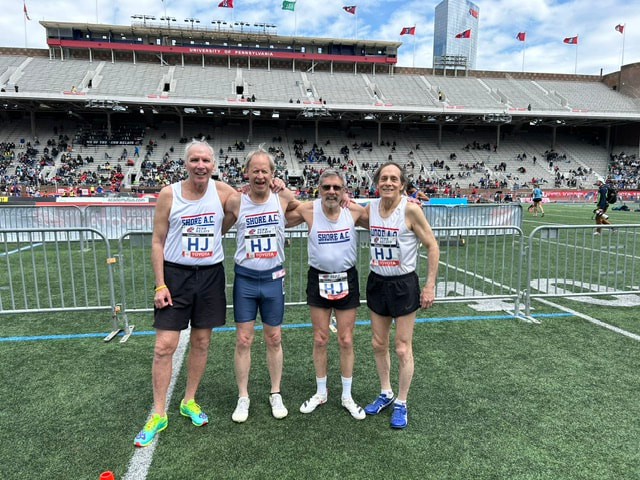 The running of the 2024 Penn Relays on April 25 saw a variety of both open and relay Shore A.C. teams perform very well in both the open 100 meter dash, along with the 4 x 100 meter relays and 4 x 400 meter relays. In the men’s 70-Over 100 meter dash, club runner Ivan Black had one of his best races ever, finishing third in 17.11, while in the women’s 40-Over 100 meter, it was Murelhena Walles just being nipped at the finish line to place second in 13.74 to the winning time of 13.66 The men’s 70-Over 4 x 100 relay ran an excellent time of 1:05.7 to grab a third place thanks to the explosive anchor leg of Rick Lapp, who passed the fourth place team runner down the homestretch. He was proceeded by Dave Gritz, Ivan Blac, and Kerry Gillespie. In the women’s 40-Over 4 x 100 meter relay, the championship went to the Shore A.C. team of Dianne Essilifie, Nichole, Govan, Eusheka Bartley and Maurelhena Walles in 54.50 The men’s 4 x 400 relays saw the SAC enter teams in four different age divisions. Best finish of the day for the club was the 70-Over team of Kerry Gillespie, Harry Nolan, Ivan Black and Rick Lapp who finished first in their race in 5:22.48. The 60-69 team, running in the same race, clocked in with a fine 4:37.32 to finish third against the other teams in their age group. Rick Lee, Keith McQuitter, Rich Alexander and Matt Wallack represented the club in that race. In the 50-59 4 x 400 meter race, the SAC team of Ron Brock, Brian Hill, Greg Calhoun and Paul Keefe finished fifth in the eleven team race in 4:16.22. Brocks time of 59.15 was the best time of the day of all the club entries. The clubs kids in the 40-49 ran very respectively against some of the top 40+ teams in the country, finishing sixth in 4:53.30. That team was made up of Matt Coleman, Chris Rinaldi, Michael Connolly and Harris Gibson. For Rinaldi, it was his first race back after a serious accident this past December. 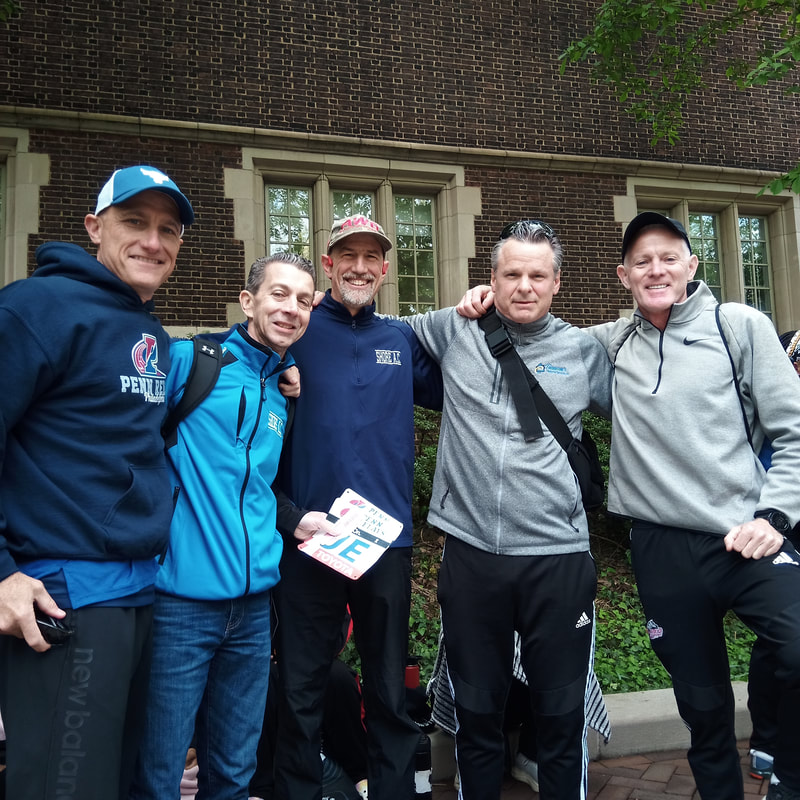 By Elliott Denman
More verrry good news by our illustrious Shore AC athletes... !!!!! Competing at the University of South Carolina Invitational Meet in Columbia, SC on Saturday, April 20th, Shore AC stalwart Josh Awotunde unleashed a brilliant winning toss of 21.80meters / 71 feet, 6.25 inches in his first shot put competition of the year!!! What a great way to open the season!! What a great omen of much better things to come this Olympic year !! I believe it was Number One throw in the world early this outdoor season and sixth best in the world this year (five indoor marks on top of a list led by Olympic champion and world-record-holder Ryan Crouser at 22.80). Crouser is the only USA athlete ahead of Josh in 2024) And it wasn't very far off Josh's all-time best of 22.29 he attained placing third in the 2022 World Championships !! Josh is a graduate of New Jersey's Delsea High School and the University of South Carolina. Take note, too, that Shore AC member C.J. Licata, the Princeton University graduate competing as a graduate student at the University of South Carolina, placed second with a tremendous/great throw'of his own, 67feet, 3.5 inches !!! Way to go !! And speaking of USC (South Carolina, not Southern California) be reminded that Shore AC's (and the state of New Jersey's) longest-ever discus throw, the similarly illustrious Art Swarts, is a South Carolina, grad, too. Stay tuned for even better news as the Olympic Year season rolls right alon 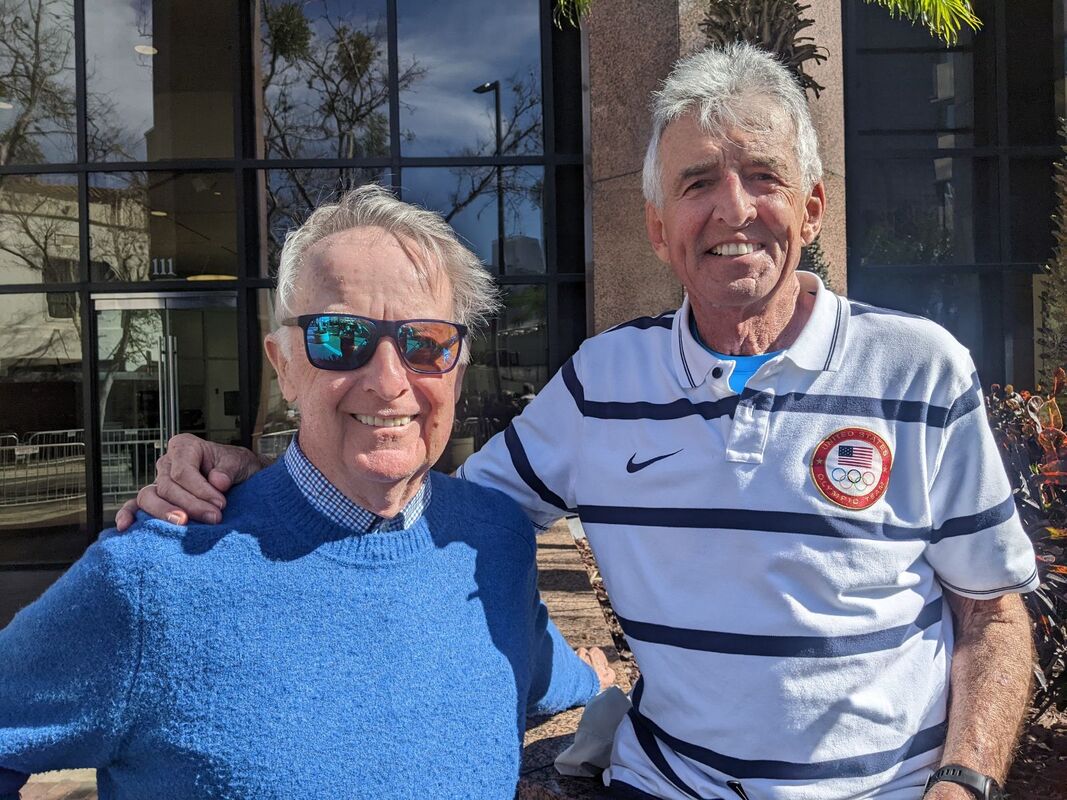 Walter MacGowan served as president of The Shore Athletic Club for almost 25 years. He is a dedicated member of the Jersey Shore Running Club and Ocean County Running Club. During his time as president of the Shore A.C.; Walter covered a lot of ground. He competed in local races and USATF long distance running events. He offered his place of business as a home to the club and directed several board meetings annually out of MacGowan Realty in Spring Lake. Walter managed club-hosted events including the Lake Takanassee Summer Series, the Adult XC Series and the Annual Awards Banquet, while also bringing on board Race Directors to assist with the planning and production of each event. He started a club internship program for student athletes part of Monmouth University’s cross country and T&F team. This plan of action gave young adults professional experience in their sport’s industry. Professional runner, Olympic Trialist and All-American Collegian runner, Allie Wilson, was one of his recent interns.
Walter has been a great ambassador of the sport and club supporting youth initiatives, elite, open and masters USATF competition, local community running events and their working committees. Walter’s vision to encourage operational support has positioned the club to grow and impact lives daily. The club is in an effective state of affairs to deliver on its mission “To develop junior and youth, men’s and women’s open and masters track and field athletes, distance and cross-country runners and racewalkers. We strive to activate the human spirit by providing competitive events for all ages and groups, and to promote the entire sport, in all its categories as lifetime activities.” Walter plans to stay involved and now serves as a Lifetime Trustee on the board. A sincere thank you to Walter for all his time, energy and support over the past two decades. The Shore Athletic Club is and will be forever grateful. By ELLIOTT DENMAN
THE FOUR-DAY USATF National Masters Track and Field Championships in Chicago is now a wrap and our Shore AC delegation, we are oh-so-proud to say, has wrapped itself in glory. With a an amazing total of 237 events in the book, the gathered athletes from all over the nations displayed their speed, stamina, strength and skill in age brackets from 25-29 to 94-99 !! Wow!! A total of 121 club teams broke ino the scoring column and the Shore AC delegation - a rather mini-group with just a fraction of us able to get to The Windy City - covered itself in glory. We placed 9th of the 121 combined men's and women's teams with 139 points, 6th of the men's squads with 93 points, and d, and 14th of the women's teams with 46 points. . Potomac Valley (500.5 points) led over-all scoring, So Cal (465) topped the men and TNT(294) the women- but Shore AC, left a whole bunch of noted teams well behind when all the results were tabulated, which was a chore unto itself. Gold medal performances by Dr. Ivan Black and Spider Rossiter were features of Shore AC's Sunday showing. Dr. Black, who'd previously won the M75 triple jump, added another gold by long jumping 10-10 1/2. And he brought his gold medal total to a brilliant five with legs on three separate non-club relay events, Rossiter, who'd previusly won the M70 mile, added another win with his 2:47.21 800 meters. Maurelhena Walles added a bronze with her 4th place in the W45 200 in 28.54. John Kuhi ran 7th in the M75 800 at 4:52. In addition to Black and Rossiter, Shore AC's double gold medalists in club scoring over the four-day meet were racewalker Israel (Jerry) Soto-Duprey (M50), who struck gold in the Thursday and Friday sessions, while throws superstar Oneithea (Neni) Lewis (W60) won a pair of golds on Saturday. The Shore A.C. Masters teams had a good day at the 2024 edition of the famed Millrose
Games in New York. The club this year entered men’s teams in both the 40’s, 50’s, 60’s and 70’s age group races of the 4 x 400 Relay, with all four teams doing very well. Best of all was the 60’s team comprised of Keith McQuitter, Bill Hughes, Rick Lee and Matt Wallack outracing all other 60’s teams to score a win in 4:30.91, outlasting the second place team, CPTC Tracksmith, who clocked in a 4:31.64. It was the second year in a row that the 60’s team won this event. In a hot race in the 70’s 4 x 400 Relay, the Shore A.C. went head to head with the pre-race favorites, the Houston Elite, an all-star team based in Texas, only to loose due to a baton mishap. The team of Spider Rossiter, Rick Lapp, Harry Nolan and Ken Wilson were running head to head with Houston, with Nolan having passed there runner on the third leg, only to have a lapped runner who Nolan passed on the homestretch stumble and knock the baton out of his hand, loosing valuable seconds in recovering the baton, and allowing Houston to gain a lead that the Shore A.C. could not reduce. The club clocked in with a 5:20.04 to Houston’s 5:13.79. In a second section, the clubs 40’s and 50’s teams were in a hot battle with teams in each age group. The 40’s team, with Matt Colman, Dan Cambell, Jason Bavaro, and Rich Alexander landed a fifth place in good field in 4:27.37, while the clubs 50’s team also ran to a fifth place in 4:22.48. The 50’s runners were Brian Hill, Paul Henry, Ron Brock and Greg Calhoun. In the open club Distance Medley event, the clubs open runners outdid themselves by claiming a third place in a fast 10:07.89, just out leaned by the Pacers/GRC New Balance team, who were timed in 10:07.89 for second place. Brian Hill, Jr., Micheal Twist, Michael Zurzolo, and Jack Shea comprised one of the best DM teams the club has entered over the years at Millrose. The team was organized by club Vice-President Coach Joe Compagni In the invitational One Mile Race Walk, the clubs one entry had a good day. The race, billed as the USATF men’s Mile RW championship, was won by Nick Christie of the New York AC, in 6:01.14. Top club race walker Rich Luettchau clocked in with a good 5th place in 6:58.99. Sitting trackside once again for over seventy years, was the Shore A.C. founder and 1956 Olympian Elliott Denman. Denman, now 90, has been a fixture at this an many other major track events, as both a competitor, sports reporter and spectator going back to the 1940’s. |
AuthorShore AC Archives
July 2024
Categories |
 RSS Feed

|
Connect with us on Social!   The Shore A.C.
P.O. Box 74 Belford, NJ 07718-9998 |
|
© 2023 Shore Athletic Club. All Rights Reserved
|
Website Developed by White Custom Marketing
|